

Guides & Resources
CRA Compliance Funding for SMEs: Up to EUR 30,000 from the SECURE Open Call
Read More


Guides & Resources
The EU Cyber Resilience Act does not have a single “CRA standard.” It has a landscape of standards: three distinct strands, developed by different standardisation bodies, targeting different product types, and running on different timelines. Together they form the technical backbone of CRA compliance.
With CRA vulnerability reporting obligations coming into effect on 11 September 2026 and full compliance required by 11 December 2027, manufacturers need to understand which standards apply to their products, where each draft currently stands, and what they should be doing right now.
This article walks through all three strands, the cross-vertical annexes that tie them together, the current status of every major draft, and the practical steps every manufacturer should be taking today.
In February 2025, the European Commission adopted standardisation request M/606 through Implementing Decision C(2025)618. This formally requested the three European Standardisation Organisations (CEN, CENELEC, and ETSI) to develop a set of harmonised standards in support of the Cyber Resilience Act. All three ESOs accepted the request in April 2025.
If you are new to what harmonised standards are and why they matter, our earlier article covers the fundamentals. In brief: when a harmonised standard is referenced in the Official Journal of the EU, a product that conforms to it benefits from a presumption of conformity with the CRA essential requirements that standard covers (Article 27). For Important Class I products, this is especially significant as it enables manufacturers to self-assess rather than engage a notified body.
The Commission’s own language states that M/606 requests a total of 41 standards. However, when you count the deliverables in the CEN-CENELEC/ETSI work programme, the total depends on how you count. The work programme includes supporting documents like the vocabulary standard (EN 40000-1-1) and a Technical Report on threats (TR 40000-1-5) that sit outside the strict horizontal/vertical split. Some sources count 42 by including these; the Commission counts 41 by referencing the numbered line items in the M/606 annex. The number is less important than the structure. What matters for manufacturers is understanding which standards apply to their products.
The CRA standards landscape is organised into three strands:
Strand 1: EN 40000 (Horizontal). Developed by CEN-CLC/JTC 13, this series applies to every product with digital elements regardless of category. It covers principles, vocabulary, vulnerability handling, and generic security requirements. This is the baseline every manufacturer must meet.
Strand 2: ETSI EN 304 6xx (Vertical, IT and Consumer). Developed by ETSI TC CYBER’s EUSR working group, these are product-specific standards covering categories like browsers, VPNs, operating systems, routers, and smart home devices. They apply to Important and Critical class products as defined in CRA Annexes III and IV.
Strand 3: EN 50770 (Vertical, OT). Developed by CLC/TC 65X, these are operational technology profiles built on IEC 62443. They run alongside the ETSI standards for product categories that have both IT and OT variants.
Each strand has its own delivery timeline and degree of maturity. The sections below walk through each one in detail.
The EN 40000 series is the cornerstone of the CRA standards framework. Developed by CEN-CLC/JTC 13 Working Group 9, it provides the horizontal baseline that applies regardless of product category. The series comprises five documents.
EN 40000-1-1 (Vocabulary) defines the common terminology used across the entire standards landscape. Terms like “risk,” “vulnerability,” “remediation,” and “asset” are precisely defined here and referenced by all other parts and the vertical standards. Status: public enquiry closed, under approval.
EN 40000-1-2 (Principles for Cyber Resilience) is the heart of the framework. It establishes four cybersecurity principles: risk-based approach, security by design, secure by default, and transparency. It also sets out a structured risk management methodology and ten cybersecurity lifecycle activities spanning from product planning through to decommissioning. The standard introduces the Cybersecurity Supplier Agreement (CSSA) for managing supply chain security responsibilities. Status: public enquiry closed, delivery targeted for August 2026.
EN 40000-1-3 (Vulnerability Handling) defines a six-phase vulnerability lifecycle with 59 mandatory requirements. These cover SBOM maintenance, coordinated vulnerability disclosure, and security update distribution. This standard is directly relevant to the September 2026 reporting obligations and manufacturers need vulnerability handling processes in place well before that date. Status: public enquiry closed, delivery targeted for August 2026.
EN 40000-1-4 (Generic Security Requirements) is the technical requirements catalogue mapping to CRA Annex I Part I(2)(a) through (m). It covers thirteen areas including access control, confidentiality, integrity, data minimisation, availability, attack surface minimisation, and logging. Approximately two-thirds of its requirements draw from the EN 18031 series, giving RED-compliant manufacturers a meaningful head start. Status: still under development, public enquiry expected mid-July to mid-November 2026, delivery target October 2027.
TR 40000-1-5 (Threats and Security Objectives) is a Technical Report rather than a normative standard. It provides a structured mapping of threats to security objectives, serving as a starting point for the risk assessments that EN 40000-1-2 requires. Status: TR Vote stage.
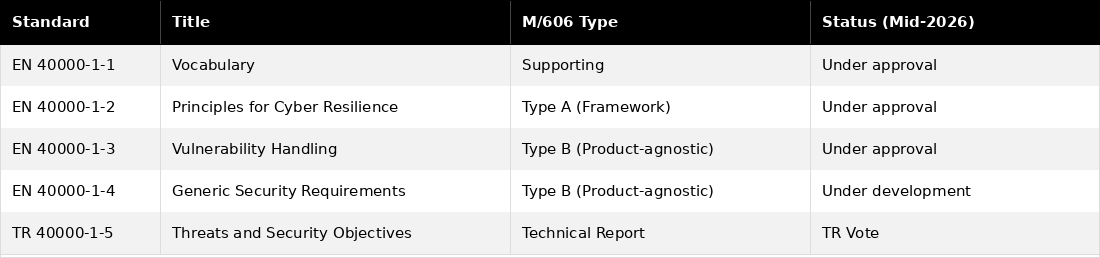
The key gap right now is Part 1-4. It contains the detailed technical security requirements that products must meet, but its October 2027 delivery target leaves manufacturers with limited runway before the December 2027 full application date. Parts 1-2 and 1-3 are much further along and should be the immediate focus for any manufacturer preparing now.
The ETSI EN 304 6xx series provides product-specific requirements for IT and consumer products. Each standard corresponds to a specific M/606 line item and covers one product category. These are the vertical standards that apply to Important Class I, Important Class II, and certain Critical products.
ETSI has taken an unusually open approach to development. Drafts are published for free in the ETSI CYBER-EUSR Open Area and through the ETSI Labs STAN4CRA repositories, far earlier than is typical for European standardisation. This means manufacturers, SMEs, and open-source contributors can read and provide feedback well before formal publication.
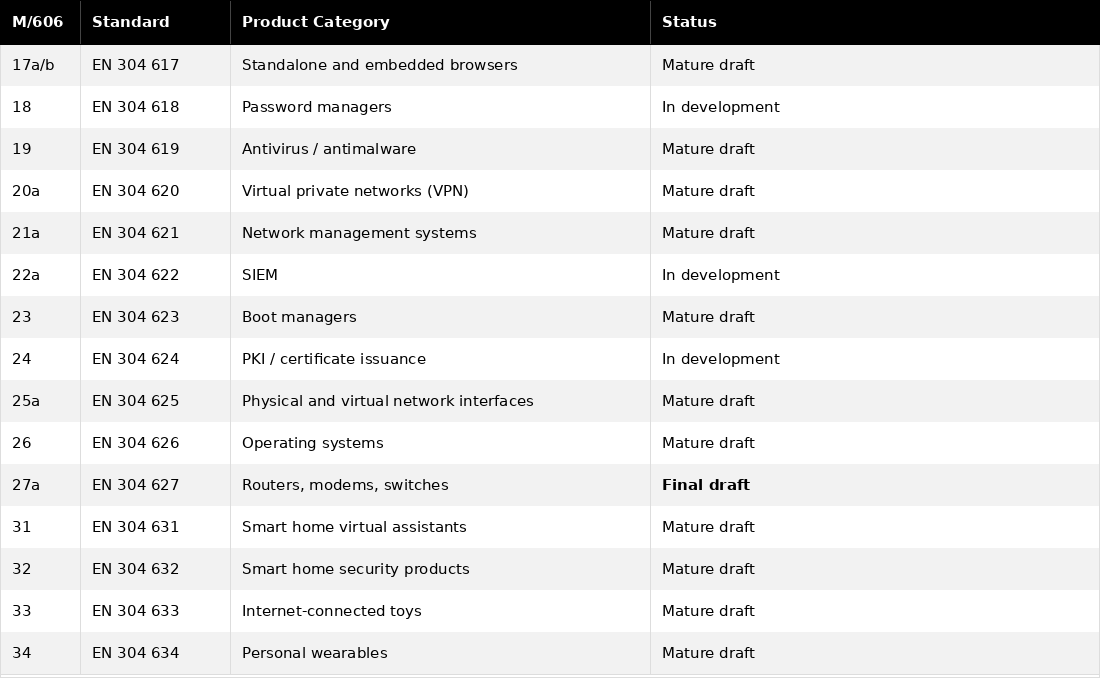
The Important Class I vertical standards are the most numerous group. These cover products where a published harmonised standard unlocks self-assessment by internal control. The table below shows all 15 ETSI Class I standards and their current status.
EN 304 627 (routers, modems, and switches) is the furthest along of any vertical standard, having reached final draft status. The majority of remaining EN 304 6xx drafts are at the “mature draft” stage, meaning the technical content is largely stable. A few standards are not yet publicly available, including EN 304 618 (password managers), EN 304 622 (SIEM), and EN 304 624 (PKI).
Identity management systems (M/606 line 16) and microprocessors with security functions (EN 50765, lines 28-29) are handled by CEN-CENELEC rather than ETSI.
Class II products require third-party assessment by a notified body regardless of whether a harmonised standard exists. The standards still serve as the technical benchmark against which conformity is assessed.

Critical products under CRA Annex IV include hardware security devices, smart meter gateways, and smartcard platforms. Standards 39 and 40 are being developed in a restricted setting due to the sensitivity of these product types, which is why their drafts are not publicly available. EN 50764 (smartcard platforms) and EN 18330 (application layer) have both closed their public enquiry.
A third strand that is often overlooked in discussions of CRA standardisation is the EN 50770 series for operational technology. Developed by CLC/TC 65X, these standards provide OT-specific profiles that run alongside the ETSI standards for product categories where both IT and OT variants exist.
The series currently includes six profiles: OT firewalls (prEN 50770-1), OT network management (prEN 50770-2), OT network interfaces (prEN 50770-3), OT VPNs (prEN 50770-4), OT routers and switches (prEN 50770-5), and OT SIEM (prEN 50770-6).
The EN 50770 series is built on the IEC 62443 family of standards for industrial automation and control system security, supported by annex adaptations of IEC 62443-3-3 (system requirements), IEC 62443-4-1 (secure development), and IEC 62443-4-2 (component requirements). All EN 50770 drafts are currently in development and at an earlier stage than the ETSI verticals.
For OT manufacturers, IEC 62443 remains the central practical reference point today. The EN 50770 series will eventually provide the formal CRA harmonisation layer on top.
One of the most architecturally significant recent developments is the endorsement of cross-vertical informative annexes under the ETSI EUSR work. Rather than each vertical standard independently reinventing its approach to cryptography or software updates, with the inevitable inconsistencies that would result, these shared annexes provide a common foundation that individual product standards can reference.
Three cross-vertical topics have now been endorsed.
Annex K: State-of-the-Art Cryptography. The CRA requires products to protect data using “state of the art” mechanisms, but the regulation deliberately avoids specifying which algorithms or key lengths qualify. Annex K provides the common baseline, aligning cryptographic requirements and assessment criteria across all CRA vertical standards. This ensures that a VPN standard and a router standard do not set contradictory expectations for the same underlying cryptographic properties. Given active debates around algorithm selection and post-quantum cryptography transition requirements, this cross-vertical alignment is essential.
Annex R: Remote Data Processing Solutions (RDPS). The CRA explicitly includes RDPS (cloud backends, remote processing components) as part of the product. This creates practical assessment challenges: how do you scope what counts as an RDPS, and how do the requirements change depending on whether processing happens locally or remotely? Annex R standardises the approach to RDPS scoping and assessment across all product categories, which is critical given that the majority of modern digital products depend on cloud backends of some kind.
Secure Update Packages: Trusted Software Updates. This annex harmonises requirements for trusted, resilient, and verifiable software updates across all product types. It directly implements the CRA’s emphasis on secure update distribution under Annex I Part II, ensuring consistency in how update authenticity, integrity verification, and distribution mechanisms are handled regardless of whether the product is a browser, a router, or a smart home device.
These cross-vertical annexes sit between the horizontal and vertical layers, preventing duplication and inconsistency across the EN 304 6xx series. For manufacturers whose product portfolios span multiple categories, this harmonised approach means they can apply a single cryptographic posture or update architecture across their entire range.
The relationship between the three strands follows a clear hierarchy, and understanding it is key to knowing what applies to your products.
Every manufacturer of a product with digital elements must comply with the horizontal EN 40000 series. This provides the principles (Part 1-2), the vulnerability handling framework (Part 1-3), the generic security requirements (Part 1-4), and the shared terminology (Part 1-1). This is the baseline.
Manufacturers of Important or Critical products must additionally comply with the relevant vertical standard for their product category. For IT and consumer products, this means an ETSI EN 304 6xx standard. For OT products, it means an EN 50770 standard. The vertical standards build on the horizontal baseline, adding product-specific requirements, threat models, and assessment criteria tailored to the risks and deployment contexts of each product type.
The cross-vertical annexes (Annex K, Annex R, Secure Update Packages) provide shared technical positions on topics that cut across all product categories, ensuring consistency between the vertical standards.
For default category products (those not listed in CRA Annexes III or IV), the horizontal EN 40000 series alone provides the compliance framework, and self-assessment via internal control is the conformity route.
For Important Class I products, the horizontal series plus the relevant vertical standard together form the compliance framework. When both are published as harmonised standards in the Official Journal, self-assessment via internal control is available. Without a published harmonised standard, alternative conformity routes are needed.
For Important Class II and Critical products, third-party assessment by a notified body is required regardless of whether harmonised standards exist, though the standards still serve as the technical benchmark.
As of mid-2026, no CRA harmonised standard has been approved or cited in the Official Journal. The presumption of conformity under Article 27 is therefore not yet available for any product category. Every standard in the landscape is still a draft at some stage of the approval pipeline.
However, real progress has been made. On the CEN-CENELEC side, EN 40000-1-1, 1-2, and 1-3 have all closed their public enquiry and are under approval. On the ETSI side, EN 304 627 (routers, modems, and switches) has reached final draft status, making it the most advanced of any vertical standard. The majority of remaining EN 304 6xx drafts are at the mature draft stage. Several CEN-CENELEC standards (EN 50764, EN 50765, EN 50766, and EN 18330) have also closed their public enquiry.
The most significant gap remains EN 40000-1-4 (generic security requirements), which is still under active development. All EN 50770 OT profiles are also in development.
The first standards are expected to be delivered in the second half of 2026, with Official Journal citation to follow on a timetable the Commission has not yet confirmed.
The CRA timeline creates genuine urgency. The regulation’s essential requirements are already law. The standards provide a method for demonstrating conformity, but the obligations exist independently of whether harmonised standards are published.
11 September 2026. Vulnerability reporting obligations begin. Manufacturers must report actively exploited vulnerabilities to the relevant CSIRT and ENISA within 24 hours. Read our full guide to the September 2026 deadline.
11 December 2027. Full CRA application. All essential requirements in Annex I must be met for products placed on the market.
Curious about where your organisation stands today? Take the free CRA Readiness Assessment to find out.
Here are the steps every manufacturer should be taking now.
The principles, structure, and scope of the requirements are clear even while the exact wording is being finalised. Manufacturers who align with the emerging standards now will be best positioned when the CRA deadlines arrive. Those who wait for final publication risk finding themselves non-compliant with no time to catch up.
As these standards develop, our platform is being built to align with them so your conformity process stays up to date as requirements change.

 Downloadable Assets
 Download File